
but more significantly, London’s reputation has not recovered since the 2008 financial crisis, which required far bigger bailouts in this country than elsewhere, indicating the scale to which UK finance failed.
Germany’s bailouts were very much larger.
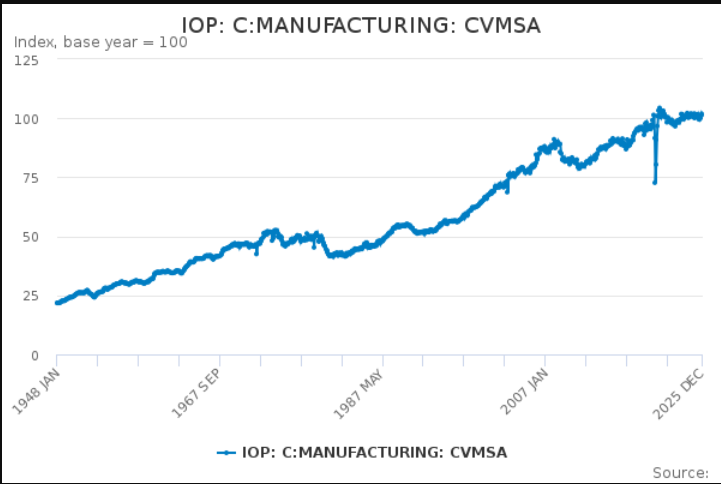
Margaret Thatcher destroyed manufacturing in the UK
Manufacturing output was up higher when Maggie left office than when she entered it.
Thatcher was utterly confused when it came to economics. She thought that a £1 increase in the value of activity undertaken to meet human need was equivalent to a £1 increase in the value of a financial asset, like a property or a share, when that is utterly untrue.
Maggies wasn’t stupid enough to confuse income with wealth.
and inflated the exchange rate to bring hot money into the UK, at a cost to us all in terms of inflation,
A higher exchange rate reduces inflation….
What is hot money? (other than an obvious and childish rhetorical device)
Nice one, Timothy. The bugger is too idle even to Google.
wibble wibble and therefore Google is neo liberal so can’t be trusted.
And too thick to understand the answers it produced, even if he did.
If you have an overseas bank account or want to exchange currency or spend more than fifty quid while on holiday, thank the memory of Margaret Thatcher. People forget what she inherited.
Just as people forget what Cameron inherited from Blair-Brown (much as I don’t like Cameron or May).
Yeah, but they doubled down on that legacy and made no attempt to change tack. Apart from the largely imaginary ‘austerity’.
Specsavers. I literally pay less for specs today than my mother did in the 1980s.
National Express. Despite all the sneering about it, far better than before.
I buy mine from a California website. Far cheaper than UK. Ever more cheaper than here.
Out of interest what’s the lead time on an order in the UK? I get mine made & delivered out China in about ten days. That might give you a clue to where yours are actually manufactured.
Thatcher did not abolish the £50 spend on holiday. It was abolished in 1970.
Introduced in 1966, abolished in 1979.
Rubbish. Abolished first of January 1970. Let me see your evidence. Here’s mine:
https://www.nytimes.com/1970/01/02/archives/britain-frees-tourist-spending-abroad.html
The 50 Pound limit was raised to 100 in 1970. The whole scheme was scrapped in 1979.
Frank was too busy being a petty bitch (twice!) to pull some text to prove his point to those without NYT accounts. So I did. The following is edited of OCR and HTML horrors, and excerpted from the whole to remove waffle and bring it within fair use. No technical information has been altered, and no effort was made to verify the NYT output.
.
.
”
The British Government lifted tonight its unpopular restriction on the amount Britons could spend on vacations abroad. The decision, reflecting Britain’s economic recovery, abolishes the annual limit of £50 ($120) on travel spending imposed in July 1966, to inhibit the outflow of Sterling. Now Britons will be able to spend what they wish on vacations.
The restriction had been attacked by British travelers who said they were humiliated at foreign resorts by being forced to pinch pennies. Since the end of World War II, except for a brief period of four months in 1947, Britons have had their vacation spending restricted by varying amounts. Americans who travel abroad are not subject to limitations on the dollars they take or spend. In 1968, concerned about the flow of dollars abroad, the Johnson Administration proposed to discourage heavy tourist spending by taxing travelers, but the plan died in Congress.
Apart from illustrating to the world financial community that Britain has made important strides toward real economic recovery, the decision will prove politically valuable to the Government of Prime Minister Wilson. General elections may be held this year and the removal of the travel curbs undoubtedly will be of some help to his embattled Labour Party at the polls. The economic price of the decision was low. At the time the limit went into effect in 1966, the Government estimated the savings in Sterling outflow at $96‐million a year. But the estimate was later lowered to $60‐million because of the number of low‐cost package tours offered British travelers. Even the lower estimate of the savings was misleading. While Britons generally are law abiding people, many of them evaded the restrictions either by slipping money into their shoes or by arranging for funds from friends overseas.
The Treasury explained that there would still be restrictions to prevent the unauthorized export of Sterling. It remains illegal, for example, for Britons to obtain foreign exchange for travel and then use the money to buy foreign stocks, land or houses. As a technical precaution, the Treasury said it would limit the amount of foreign currency Britons could obtain freely here to $720 for each vacation, as opposed to the old limit of $120 a year. But officials made it clear that more could easily be obtained on application for travel expenses.
There is no limit to the number of journeys for which foreign currency can be obtained, the Treasury said, or to the amount of currency allowed for genuine travel expenditure. But certain checks will be maintained in cases where unusually large amounts of currency are applied for. In addition to the foreign currency purchased in Britain for trips, a traveler may also take £25 ($60) in Sterling with him. This is $24 more than allowed previously. The amount of foreign currency obtained in Britain will continue to be noted in the traveler’s passport.
”
.
.
According to this the £50 absolute (for plebs) annual limit was replaced with a £300 “freely available” limit per trip (but with more allowed if the pleb applied nicely up to an unspecified level subject to “certain checks”. This is for money exchanged into foreign currency within the UK (the amount recorded in the pleb’s passport). If the pleb wanted to take Sterling (to visit multiple countries, perhaps) a limit of 25 quid was in place.
Whatever of this bollocks remained in 1979 is what Maggie got rid of.
Rubbish. Abolished first of January 1970. Here’s my evidence:
https://www.nytimes.com/1970/01/02/archives/britain-frees-tourist-spending-abroad.html
Where’s yours.
I don’t know. Wikipedia says 1979, but it’s a bit vague, and its sources are even vaguer.
https://en.wikipedia.org/wiki/Exchange_controls_in_the_United_Kingdom
I note that there was a debate on the question on 27th November 1969 where it was rejected 294 to 239. This might be the source of the NY Times’ confusion.
https://www.theyworkforyou.com/debates/?id=1969-11-27a.657.2
NY Times confused?
Sort of correct. The £50 annual (!) limit was raised to £300 per trip in 1970, with no limit on the number of trips per year, but not totally abolished. Given inflation from 1970 to 1979 was about 180% the purchasing power of that £300 had dropped considerably by the time Maggie abolished it totally.
https://time.com/archive/6875239/britain-first-of-the-goodies/
If I remember rightly, the covert foreign currency arbitrage operation was still functioning in ’72
This something governments seem incapable of understanding. If you tax something or otherwise mess with the market price. Eg by making it illegal. It’s an iron law of economics, someone will create a business & a profit out of evading what you’ve done. The more onerous the action the greater the potential profit.
He still bangs on about needs and ignores – or denigrates – wants.
That’s because you define your wants, he defines your “needs” (in his diseased imagination).
Quickly googling, exchange controls stopped money leaving, but didn’t stop money entering.
So, how did it work with furriners coming here to work and then going home? How did Australians come to sheer sheep in the Ozzi off season take their earnings back home with them? How did the 1970s version of Polish potato pickers take their earnings home?
The crop-picking was done by Brits as a kind of holiday before the 70s. Foreign exchange was recorded in your UK passport, it didn’t apply to foreigners IIRC.
A further recollection. I was in the army in Germany. We were paid in Deutschmarks and I don’t remember any checks on money at customs for the Zeebrugge ferry. The £50 limit was about a week’s pay but if you took a package holiday that allowance was reduced by an amount estimated as the exchange amount in the package price, so you might only be allowed to take £30 or so.
So furriners could bleed the country dry of as much money as they wanted, it was only UK citizens who were prevented from taking their money with them if they tried to flee.
Even Attlee’s government didn’t pretend to have control of foreigners personal cash.
There would have been a lot fewer foreigners in those days;)
But yes, it was to prevent subjects from fleeing. You can’t allow the tax sheep to leave the herd.
Mrs T was also responsible for the spread of the Black Death in the UK in the 14th century and the Great Plague in the 17th century. Many people forget that.
The bailout thing is a stupid claim anyway as London is a bigger market than e.g. Frankfurt so you’d expect the amount to be bigger.
Many people would claim that the decline of the London market is due to excessive regulation, the sort that he always likes.
Deutsche Bank very nearly took the German economy down with it.
Pretty sure most of it got paid back, too. Apart from the losses made by nationalisation of banks.
Edinburgh is a smaller market than Frankfurt. There were two bail-outs of two banks both of whose Headquarters were within walking distance of Alastair Darling’s constituency. One of the bail-outs was performed by a private-sector bank in which I have/had a shareholding after Gordon Brown “had a conversation with” the Chairman of Lloyds Bank.
It is also true that neither bank would have needed a bail-out if Gordon Brown had not chosen to tax imaginary future profits on bank lending (the possibility that a loan would go sour and stop paying interest and repaying capital more than twelve months in the future had to be ignored by HMRC – most loans turn sour a lot more than 12 months after they are made – so that Brown could lie about the extent of his profligacy).
I said at the time that the story would have been different had it been the Royal Bank of Somerset and Horsham Bank of Surrey.
Lloyds sent me a cheque for 56p for my shares.
I pinned it to the fridge. They then had the temerity to ask why I hadn’t cashed it.
He made a video today called the politics of blame and how mindless it is. Then in the next post turns around and blames thatcher for everything.
I bet he looks under the bed for the ghost of Fatcher every night.
You are talking a man who is the embodiment of evil in human form – an anti-semite (of European descent) the likes of which has rarely been seen in Europe since World War 2. Pit that against the greatest political leader of all time in the UK. Only one winner. Lies is all he has.
“and inflated the exchange rate to bring hot money into the UK, at a cost to us all in terms of inflation,”
It is theoretically possible for lots of inward investment to cause inflation, if for example an excess of it competed with domestic expenditures for limited resources, you could end up with a price spiral. Especially when more of the consumption within a country was domestically produced rather than imported. And no immigrant labour in the 80s, you soon got a wage/price spiral back then because excess demand would lead straight into wages. Nowadays not so much.
However one would have to wonder how a high pound would encourage inward investment, as it would make UK assets more expensive. Surely a low pound would encourage it instead?
Interestingly he has done a public service today by posting the main lines of argument against MMT. It’s interesting in that all of them expose its bankruptcy (no pun intended) and he has no valid reply to any of them.
All of this are valid critiques- not a single one is refuted by him or any other MMT advocate.
It is widely considered that Mrs Thatcher made an error of judgement in *not* interfering with the floating exchange rate. It is beyond ridiculous to accuse her of acting to inflate the exchange rate.
I also hope Burn’em’s team are reading his idiocy and follow his advice, not least because him trying to explain why the entire public sector has collapsed because of hyperinflation and wibbling on about MMT still being valid would be most entertaining!!
OT but… Burnham, Trump and Chagos.
Am I being too kind to Andeh when I suspect that even he may have been looking for a way out, and can now claim it’s not his fault because a big orange boy took it and ran away?
Starmer and Hermer’s bank balances will be pleased.
I had the same thought when I saw Streeting’s comments.
When it all falls through, would somebody pro bono sue represent the government of Mauritius in suing Sands and Hermer?
He’s not that clever.
Chagos is in the long grass, hoping a Dem is the next President. Then it’ll be magically revived.
You don’t think he’ll renegotiate the treaty arrangements to stop UKGov pulling the same stunt again?
Everything always is, Jimmers.
Another masterstroke by the Orange Man. And I gather there’s agreement being signed this week gives the US effective control of Greenland.
Also OT but… oh frabjous day!
BBC staff in tears at £2.6m cuts
But also this:
https://www.gbnews.com/money/tv-licence-fee-abolish-bbc-intenet-levy-labour
The bastards want to make everyone pay for the BBC whether they even watch any TV or not.
Of course they do. The BBC is far too important to the Progressive Establishment to be allowed to wither away.