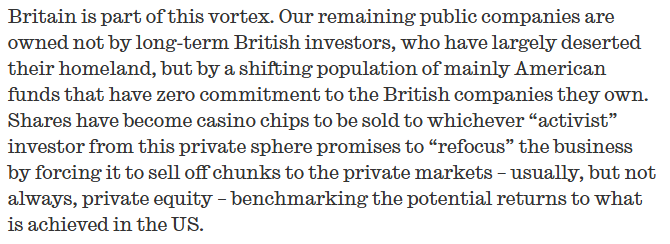
Private markets, very bad, really, terrible. All Yankee, see.
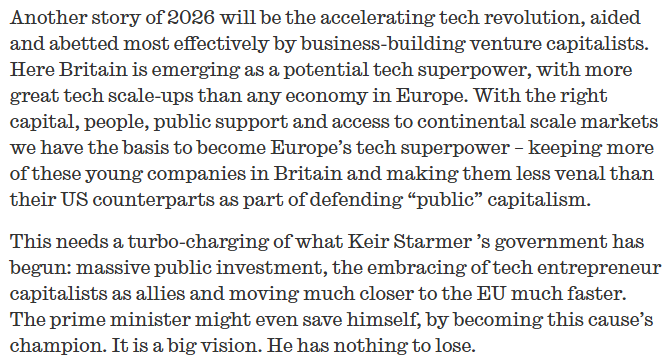
Private markets very good, see. Add work “tech” and ……
That actually from the same Willy Hutton article. He can’t even keep the story straight for a whole 1,200 words.

Private markets, very bad, really, terrible. All Yankee, see.
Private markets very good, see. Add work “tech” and ……
That actually from the same Willy Hutton article. He can’t even keep the story straight for a whole 1,200 words.

Excellent, we’re not in the EU and we’ve been able to grow our tech companies better than EU countries.*
And then he wants to rejoin the EU so they can be regulated out of business.
Wanker.
*I assume Will like every other Remaniac lazily uses Europe to mean EU
I think I’ve made my views on Wile E. Hutton clear multiple times.This is the usual level of insight I’d expect.
If Starmer says he supports something you might as well book the funeral for it the same day.
Woolly Mutton has an astute eye on the honours list. Flattery will get you everywhere. Fantasy fiction is presently the best-selling literary genre. Der Starmer couldn’t supercharge a bicycle pump. Jealous of Germany having the highest energy costs in Europe, he and Rachel want to tax private equity out of existence.
How many tech entrepreneurs have I seen crash and burn ?
Generally speaking, the ones that succeed are those that are bought out by bigger US companies.
Really has this guy been asleep for the past 30 years ?
Willy is amazed that people can’t be arsed to ask 10,000 civil servants if it’s OK to wipe your bum with your left hand on Thursdays before inventing faster than light spaceships on Friday then havine the government take 98% of your profits on Frday afternoon. He’s just fine presenting his wrting to the Ministry of Truth before it can be published provided the Minister in charge is Diane Abbott….
This is key.
They didn’t leave because they are bad people, as the commies would have you believe. Government has created an environment toxic to business.
The grand irony is businessmen have gone because UK is a bad place to invest; Hutton’s solution is for government to invest (sic)! “Real investment has never been tried.”
Here’s the interesting question – what do they owe their ‘homeland’ under a regime that says nations are, at best, administrative regions for a homogenized global polity?
If importing 20% of your country doesn’t matter because ‘all cultures are equal’ then why would it matter if 2% left? If ‘diversity is our strength’ then would not that even justify *forcibly* displacing that 2% in order that they diversify (and thus strengthen) the global order?
“Britain is emerging as a potential tech superpower..”
HOORAY!
“..with more great tech scale-ups than any economy in Europe.”
oh.
Everything Britain does is massive – if you’re only interested in what happens in Europe.
He’s not wrong about foreign ownership of assets though. Who is going to look after an asset better – people who live here and always have and are part of the scenery, or a bunch of foreigners living in Dubai with no UK ties who meet up once in a while to count their dividends and decide which underperforming bits of their empire to cull?
There’s a brewery in my town, privately owned, with a chain of pubs attached. The owners are local, I went to school with their daughter many years ago. They live in a big house in a village on the edge of town. The family have owned the business for approaching 200 years. They’ve been very canny through the tough years of pub closures, they’ve managed to keep theirs open (presumably by not expecting massive rents from their tenants) and now they have more pubs than anyone else locally, they are the last man standing in effect, so get whatever trade there is. And the brewery still operates like it always has. If they’d been taken over by private equity fund from God knows where that all would be gone. The brewery shut down and houses built on it, the pubs forced to sell all the usual national slop, and rents pushed higher and higher until tenants couldn’t continue, and then closed and turned into more houses and flats. All those jobs and livelihoods wiped out.
UK assets should be owned by UK people, because they’ve got a vested interest in keeping things going. Foreigners haven’t.
Bateman’s by any chance?
No, Arkells.
Ah, Pilsner Arkell. Lovely stuff.
I think you’re missing the scale here…
It’s quite possible to have or even build up a thriving locally produced/locally consumed venture.
All you really need is quality, a market that appreciates that quality, and decent initial investment and a shitton of luck.
And resist to urge to sell out when the Big Boys start making their takeover bids…
Imagine that same brewery + pubs to try and go National, or even International, which is the scale Daft Wullie is waffling about…
Massive investments ( money coming from where?….) and you suddenly have to directly compete with those Big Boys… Who are also the ones sitting tight on that pile of potential investors…
A local brewery with a number of pubs is not a threat to vested interests. Get too ambitious , and weeeelll….
Also you will be taxed out of business. Gordon McRuin changed the tax rules and they have been made worse since. Produce too much or too strong and unless you are a big brewer, moving into the new tax bracket will cripple you.
Foreigners have brought in capital you otherwise wouldn’t have. Those foreign owned businesses would be fucking closed if it weren’t for foreign ownership.
Those creepy foreign owners are your fucking saviors.
Ingrate.
Yes we are all saved by the wonderful foreign ownership of our utilities. I bow down to the wonderful management of Thames Water (my water supplier) by the Pension Fund of Canadian Teachers. After all their wise and benign stewardship of the assets has resulted in the company having lower prices than anyone else and a fraction of the leaks it used to have when owned by indolent Brits.
There’s a big difference between a foreigner coming here with capital and creating a new business from scratch, and buying an existing one, especially if has significant property assets. If foreigners want to come here and start businesses, have at it. If they create something from scratch they’ll probably want to look after it. Buying existing businesses with hard assets with borrowed cash on the other hand just attracts the worst sort of international wide boys, who think they can buy an asset with cheap borrowed money, do a whole load of financial engineering, extract as much profit as they can and then asset strip the rest. They can always sell the property assets for redevelopment into housing anyway. Or they just nick all the IP, send the production overseas and the UK ends up with nothing.
When an incompetent regulator decides to fuck over a utility, crummy things happen. That’s regulatory failure, Jim, not management failure. Pension funds are a terrific shareholder for utilities, having a very long-term investment horizon, which nicely matches the asset life and investment cycle of most utilities.
I suppose them paying themselves fat dividends while the company went to rat sh*t was all the fault of the regulator then?
Thames Water have increased their water charges from £1.35/m3 in 2016 to £2-47/m3 today (I have the bills to prove it). Thats an increase of 83% in 10 years. Inflation in the same period has been under 40%. If getting a real increase of 40% in your output price is considered being fucked over, perhaps you’d care to consider the case of farming, whereby we’ve hardly had a nominal increase in grain prices for over 30 years (my late father sold grain for £145/tonne in 1993, the current price is £165/tonne). Thames water should try running their business getting the same price for their water they did 30 years ago, and see how they like that.
Thames hasn’t paid a dividend to shareholders since the McQuarrie sale in 2017, Jim.
Or they just nick all the IP, send the production overseas and the UK ends up with nothing.
You aren’t getting it, Jim. YOU.ARE.WORTH.NOTHING. UK is sofa king dead.
Thus speaks the man whose economy is currently being goosed by its government borrowing/printing 6% of GDP. Those who live in glass economies built on debt shouldn’t throw stones.
Which is my point. Countries eventually have to live within their means, always. No one gets to go on living the high life on borrowed or printed money forever, one day the bills come due. The UK is going to find that out, as will the US.
No country gets to be top dog forever. They all get dethroned. The UK slid semi-gracefully off the throne, something tells me the US’s demise will be considerably more messy.
Your local owners weren’t managing them very well though. Which is why they were ripe for sale to someone who thought they could make money doing it.
The local owners were screwed over by Labour’s appointee to Ofwat so the institutional investors sold out. In Cambridge the colleges owned a majority of the shares and took a long-term view.
Foreign direct investment keeps the UK afloat, given the UK’s budget deficits and trade deficits. Selling businesses is in effect exporting: the UK exports small firms, as it were…and then creates more…
As for your other observations, see Grikrath and Gamecock above, who both make very sound points.
And micro-breweries are proliferating – at least in East Anglia…
“Foreign direct investment keeps the UK afloat, given the UK’s budget deficits and trade deficits. “
You speak like thats a good thing. Its all this foreign money that allows the idiots in charge to get away with running an economy that only functions because of constant cash injections from abroad. We wouldn’t be able to run trade or budget deficits without the foreign cash, and that would be a good thing. We’d be forced to live within our means. Instead of the politicians telling everyone they can have it all and a pony, just someone else will pay for it. Its that brand of economic management that has got us where we are today, and you want more of it.
Good point, Jim.
It’s neither good nor bad: it’s a fact.
So facts are morally neutral now are they? If I murder you thats just a fact, its neither good nor bad?
Of course not. Its a fact we are propped up by a wall of foreign money and that’s definitely bad. Because one day its going to be taken away, probably very suddenly. And then things will be very bad.
But he’s also one of those that will tell you that foreigners are just like us and will immediately form amazing strong ties to their new country.
Secondly, the reason the assets are now foreign-owned is because the local owners DID NOT CARE WHAT HAPPENED TO THEM – as long as they got their payout.
“Who is going to look after an asset better – people who live here and always have and are part of the scenery, or a bunch of foreigners living in Dubai with no UK ties who meet up once in a while to count their dividends and decide which underperforming bits of their empire to cull?”
The people who own it and want a return on investment. It’s their property, not yours.
…access to continental-scale markets… moving much closer to the EU much faster.
Poor Willy. As if Brussels or Paris would actually allow any UK tech firm to scale to the extent of being able to dominate the continental European market, or even be an equal player in it. He’s obviously never heard of Treasure Island.
Wotcha, Tim. I’ve just started reading one of my Xmas pressies, “Kaput” by Wolfgang Münchau, an account of the self-buggering of the German economy. Have you looked at it? Any views?
I must say when I used to see an article of his in the Racing Pink, I’d groan – uncritical EUphile piffle, mainly. So far so good with Kaput: maybe he’s grown up a bit in his old age.
A P.S. He describes the intimate coupling of German politicos, German state-owned banks, and major German manufacturers. There used to be a word for this sort of corporate state. I suppose it would be bad manners for a German to use the word.
The German economy was, from the 1950s onwards after the currency reform, one huge cartel. All the large firms and banks owned bits of each other and the politicians. That is why the system worked so well for so long. My ex employer was part of this, but they became too complacent. Thinking that the reunification problems had been solved, they lost sight of what they wanted to achieve.
We use “corporatism” these days. To avoid that very point….
Know v little of him and nothing about the book, sorry…..
I listen to him a lot and he’s definitely a United States of Europe proponent on the basis that the only way the EU could work, but he definitely isn’t uncritical of the EU, quite the opposite. He’s more scathing of the EU than he is of Germany and UK and he doesn’t hold back there either.
Will Hutton’s article is factually inaccurate. The large majority of long-term Btitish investors are individuals who own shares in companies/a company about which they personally know something (many through a SAYE scheme). They have not deserted their homeland.
The big institutional investors (pension funds, insurance companies, investment trusts – excluding the specialist investment trusts with a restricted mandate) have diversified portfolios to reduce risk and consequently have significant exposure to overseas stock markets but alost invariably have a higher %age of UK stocks thana worldwide indexed fund would have.
While it is true, as Gamecock states, that the UK is a relatively bad place to invest that particularly hurts small unquoted companies more than than the big companies that have shares quoted on the stock exchange as the costs of over-regulation increase lass-than-proportionately as the size of company increases.
Oh, Britain’s remaining companies are owned by people with no ties to the country?
Hmmm. I wonder what could have happened to make that possible?
Oh, I know! Its Hutton’s globalist vision and his insistence that human beings are interchangeable economic units and that culture and nation do not matter.
Well, they don’t matter until it starts to affect him.
I wonder if he’ll apply the same logic to his neighbors?